Zibo Xunfan Trade Co., Ltd. is a professional export abrasive products company. The company has more than ten years of export experience, mainly engaged in abrasives products sales, the company with its excellent quality and perfect service level to win the trust of customers from all over the world. Company sales of resin cutting disc exported to South America and North America, sand cloth and sandpaper selling in Australia, Southeast Asia and so on.Our abrasive material are mainly used in the production of coated abrasives and bonded abrasives. Abrasive tools are mainly used in the cutting of metal, stone and stainless steel, also used in grinding and polishing of wood, etc.

Why Choose Us
01
Our Factory
Zibo Xunfan Trade Co., Ltd. is a professional export abrasive products company. The company has more than ten years of export experience, mainly engaged in abrasives products sales, the company with its excellent quality and perfect service level to win the trust of customers from all over the world.
02
Production Market
Our products are mainly exported to Southeast Asia, North America, South America, Australia and Europe.
03
Product Application
Our abrasive material are mainly used in the production of coated abrasives and bonded abrasives. Abrasive tools are mainly used in the cutting of metal, stone and stainless steel, also used in grinding and polishing of wood, etc.
04
Our Service
The company has a professional sales team to provide you with high-quality pre-sales consulting services. In the order production process, customer can communicate with us at any time to keep knowing about the production progress, and also we provide high-quality after-sales service to meet the different needs of customers.

Brown fused alumina (BFA) also called brown aluminum oxide and brown synthetic corundum, which is made from high quality abrasive grade bauxite, with auxiliary materials, which is refined in electric arc furnace at high temperature above 2250℃. It has good self-sharpening and strong grinding force.

Pink fused alumina (PA) also called pink aluminum oxide, which use aluminum oxide powder as the main raw material, suitable for chrome oxide, etc., through high temperature melting.

Black Silicon carbide (SIC) is made of quartz sand, petroleum coke, wood chips and other raw materials through high temperature resistance furnace smelting.

Green silicon carbide is made of petroleum coke and high quality silica as the main raw materials, with salt as the additive. It is smelted by resistance furnace at high temperature. After smelting, the crystal has high purity and high hardness, which is between corundum and diamond and has higher mechanical strength than corundum.

White fused alumina (WFA) also called white aluminum oxide or white synthetic corundum, which is a kind of artificial abrasive. Aluminum oxide (Al2O3) content in more than 99%, and contains a small amount of iron oxide, silicon oxide and other components, is white.
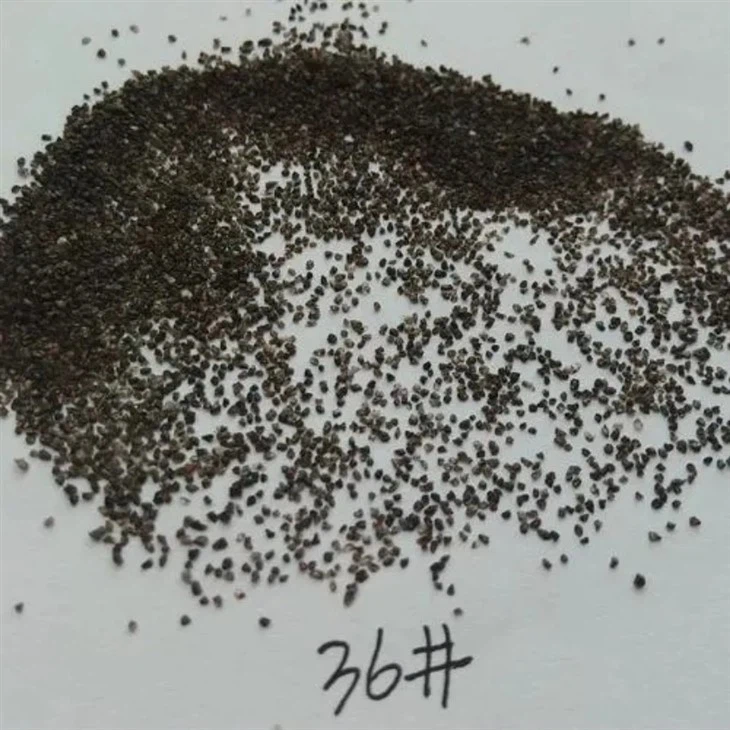
Brown Fused alumina 36#, also known as Brown Corundum 36# or brown aluminum oxide 36#, is a type of abrasive material that is commonly used for sandblasting purposes. It is made from high-quality bauxite by being melted in an electric arc furnace at high temperatures, then processed and crushed into different sizes for various applications.
What is Black Silicon Carbide
Black silicon carbide contains about 98.5% SiC, its toughness is higher than green silicon carbide, mostly used for processing materials with low tensile strength, such as glass, ceramics, stone, refractory materials, cast iron and non-ferrous metals.Black silicon carbide is made of quartz sand, petroleum coke and high quality silica as the main raw material, smelted by resistance furnace at high temperature. Its hardness is between corundum and diamond, mechanical strength is higher than corundum, brittle and sharp.
Benefits of Black Silicon Carbide
The high purity and large crystalline silicon carbide raw material of black silicon carbide abrasive ensures the excellent cutting performance and stable physical state of silicon carbide cutting micro powder.
It has high thermal shock stability and load softening temperature, which ensures the minimum linear expansion coefficient of cutting under load, so as to ensure the stability of cutting. And it has good adaptability with cutting machine.
The particle size distribution is concentrated and uniform.
After special surface treatment, black silicon carbide has large specific surface area and clean appearance, and has good compatibility with polyethylene glycol cutting fluid.
The grain size is equal product and has edge, which ensures the balanced self sharpening of black silicon carbide as cutting tool, so as to minimize the material to be cut.
Application Of Black Silicon Carbide

Abrasives
Black silicon carbide in foreign light industries are mainly used as abrasives. Because black silicon carbide has a high attitude and certain toughness, it is mostly used for grinding and polishing optical glass, cemented carbide, titanium alloy and bearing steel, sharpening high-speed steel tools, etc.; black silicon carbide is mostly used for cutting. and grinding materials with low tensile strength.
Refractory material
Black silicon carbide has good thermal shock resistance, so it is a high-quality refractory material. According to the production process of the product, it can be divided into recrystallized black silicon carbide products, high-temperature hot-pressed products, products with silicon nitride or clay as the binding agent, etc. The main products and uses are high-temperature furnace components and supports.


Electrical smelting industry
In addition to being used as furnace linings in various smelting furnaces, it is also used as a deoxidizer for steelmaking, a structural improver for cast iron, etc. The chemical composition requirements of the release agent black silicon carbide are: Compared with the traditional steelmaking process that uses coke and silicon powder for dispersion and deoxidation, the use of a release agent has the advantages of good steel quality and a good working environment.
Other fields
Electrical industry, black silicon carbide materials are also widely used as electric heating elements, high-temperature semi-superconductor materials, far-infrared panels, arrester valve materials, etc.

What Is the Difference Between Black Silicon Carbide and Green Silicon Carbide?
Black silicon carbide contains about 98.5% SiC, and its toughness is higher than green silicon carbide. It is mostly used to process materials with low tensile strength, such as glass, ceramics, stone, refractory materials, cast iron, and non-ferrous metals.
Green silicon carbide contains more than 99% SiC and has good self-sharpening properties. It is mostly used for processing cemented carbide, titanium alloy, and optical glass. It is also used for grinding cylinder liners and precision grinding of high-speed steel tools. In addition, there is cubic silicon carbide, which is a yellow-green crystal produced by a special process. The abrasive tools used to make it are suitable for ultra-finishing of bearings, and can make the surface roughness from Ra32 ~ 0.16 microns to Ra0.04 ~ 0.02 microns.
Chemical coefficient of green silicon carbide: Due to its stable chemical properties, high thermal conductivity, small thermal expansion coefficient, and good wear resistance, in addition to being used as abrasive, it has many other uses; it is used to make advanced refractory materials that are resistant to thermal shock. , small size, lightweight, high strength, and good energy-saving effect.
Green silicon carbide is suitable for grinding copper, brass, aluminum, gemstones, optical glass, ceramics, and other hard alloys, metals, and hard and brittle non-metallic materials. Its micro powder can also be used as ceramic materials. Due to its high purity, black silicon carbide is also widely used in the manufacture of refractory materials and various abrasive tools.
How To Choose Black Silicon Carbide
Consider Particle Size and Distribution
The size and distribution of silicon carbide particles play a critical role in the performance of the final product. Uniform particle size distribution ensures consistent behavior, while the size itself affects the material's effectiveness for the intended application. Manufacturers often provide a range of particle sizes, from very fine powders to coarse grains, to suit different needs.
Evaluate Purity Levels
The purity of black silicon carbide can impact its performance, especially in applications requiring high thermal conductivity or electrical properties. Impurities can introduce unwanted variability. Depending on the application, opting for higher-purity silicon carbide might be necessary to ensure optimal performance.
Assess the Source
The quality of black silicon carbide can vary between manufacturers. It's essential to source your materials from reputable suppliers with transparent production processes and quality assurance practices. This ensures you receive a product that meets your specifications and performs as expected.
Cost vs. Performance Trade-off
While higher purity and more precisely sized particles often yield better performance, they can also significantly increase the cost. Balance your budgetary constraints with the performance requirements of your application to find the best value.
Request Samples and Conduct Tests
Before making a large purchase, request samples from the supplier to conduct tests specific to your application. This can help verify that the silicon carbide meets your requirements and performs well under your operating conditions.
Consult with Experts
If you're uncertain about the best type of black silicon carbide for your needs, don't hesitate to consult with suppliers or industry experts. They can offer valuable insights based on your application specifics and may suggest options you hadn't considered.
The Production Process of Black Silicon Carbide Typically Involves The Following Steps
The main raw materials for black silicon carbide production are high-quality silica sand and petroleum coke. These materials are carefully selected and prepared for further processing.
The silica sand and petroleum coke are mixed in the desired proportions to achieve the desired chemical composition. Other additives may also be added at this stage to enhance specific properties of the final product.
The mixed raw materials are crushed and ground into a fine powder. This process helps in achieving a uniform particle size distribution, which is important for obtaining consistent product quality.
The powdered mixture is then placed in an electric resistance furnace or a graphite furnace. The temperature is raised to around 2000 to 2500 degrees Celsius in an inert atmosphere. At this high temperature, carbonization occurs, converting the mixture into a solid mass.
The carbonized mass is cooled and then crushed to break it into smaller pieces. These pieces are then sieved to obtain the desired particle size distribution. The sieved material is called green silicon carbide.
The green silicon carbide is further processed through grinding and classification. Grinding involves reducing the particle size of the material to the desired level, while classification separates the particles based on size.
To remove impurities and residual carbon, the classified silicon carbide undergoes a purification process. Acid washing is commonly used to remove metallic impurities and other contaminants.
The purified silicon carbide is dried to remove any moisture content. After drying, it is ready for packaging. The final product is typically packed in bags or containers for distribution and sale.
Factory Pictures


FAQ
Hot Tags: black silicon carbide, China black silicon carbide manufacturers, suppliers, factory, Black Silicon Carbide, SA cup grinding wheel, silicon carbide flap wheel with bore, high quality cutting disc with 14 diameter, abrasive grinding wheels for metal, Sand Cloth